
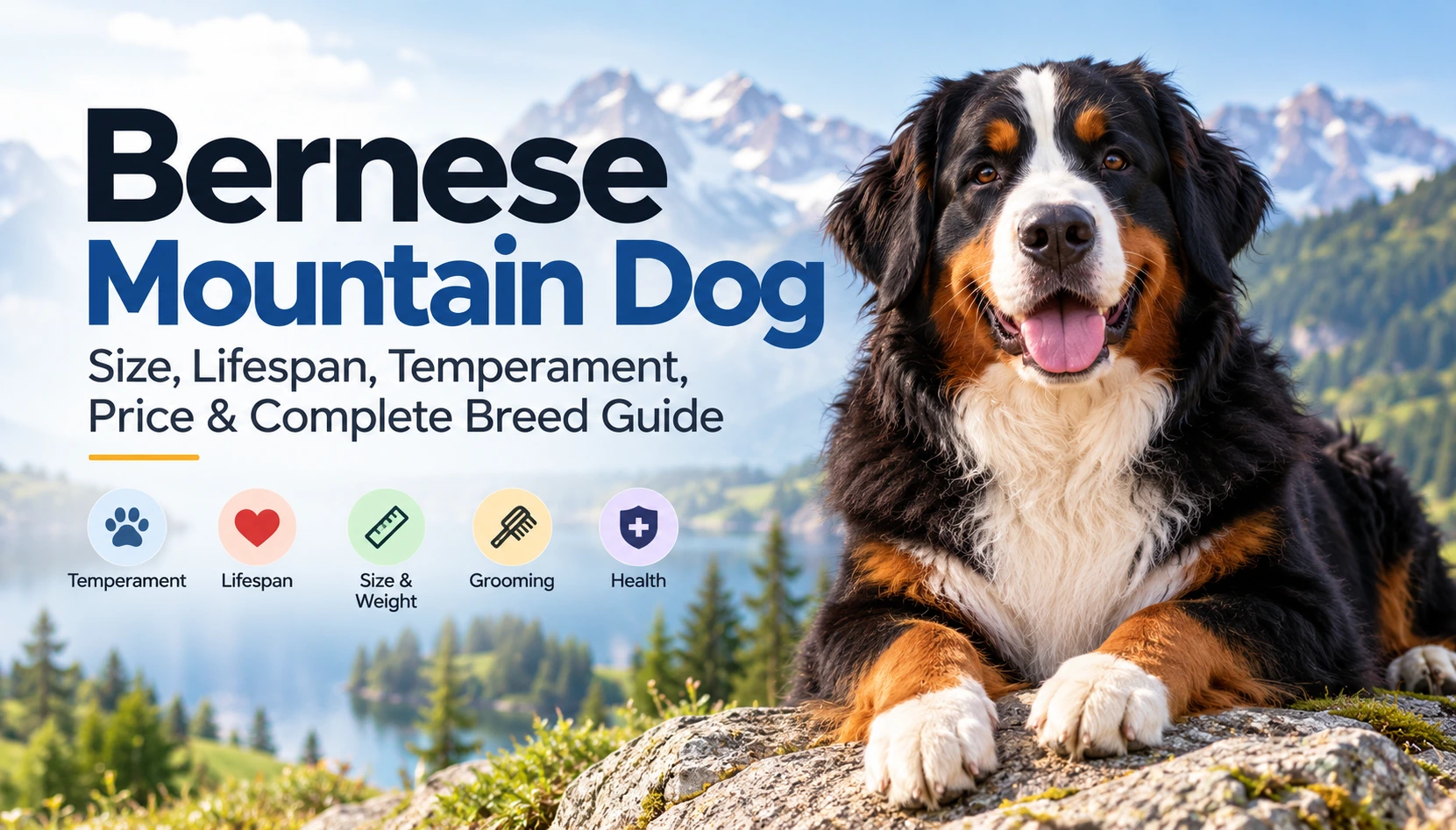
Bernese Mountain Dog is a large, striking working breed known for its black, white and rust-colored coat, gentle personality and close attachment to family. Originally developed in Switzerland as a versatile farm dog, the breed combines impressive strength with an affectionate temperament.
Bernese Mountain Dogs, often called Berners, are typically calm, intelligent and eager to spend time with their people. They can make wonderful family companions, but prospective owners should understand their large size, heavy shedding, exercise and grooming needs, potential health concerns and relatively short lifespan.
If you are considering a Bernese Mountain Dog puppy or simply want to learn more about the breed, this guide covers size, weight, temperament, lifespan, grooming, health, training, shedding, exercise, cost and everyday life with a Berner.
Bernese Mountain Dog At a Glance
| Trait | Bernese Mountain Dog |
| Origin | Switzerland |
| Breed Group | Working |
| Size | Large |
| Height | About 23–27.5 inches |
| Weight | About 70–115 pounds |
| Coat | Thick double coat |
| Main Colors | Black, white & rust |
| Temperament | Affectionate, calm, loyal |
| Shedding | High |
| Exercise Needs | Moderate |
| Training | Generally responsive |
| Family Friendly | Generally yes |
| Life Expectancy | Roughly 7–10 years |
Bernese Mountain Dog as a large, powerful working dog with a sweet and affectionate character. Adult Berners generally stand around 23 to 27.5 inches at the shoulder and weigh approximately 70 to 115 pounds.
History Of The Bernese Mountain Dog
- The Bernese Mountain Dog originated in Switzerland, where its ancestors worked on farms in and around the Swiss Alps.
- Rather than being developed for only one job, Berners served several purposes. They could help move livestock, guard farm property, accompany farmers, and pull carts carrying farm goods.
- The breed is one of the traditional Swiss Sennenhund breeds. The Bernese Mountain Dog differs visually from its close Swiss relatives because of its longer, silky coat.
- The breed declined as traditional farm work changed with industrialization, but preservation efforts helped restore its population. The American Kennel Club officially recognized the Bernese Mountain Dog in 1937.
- Today, most Berners are family companions, although some still participate in activities that The reflect their working history, including drafting, carting, obedience, tracking, and other dog sports.
Bernese Mountain Dog Size
One of the first things people notice about a full-grown Bernese Mountain Dog is its size.
These are genuinely large dogs. Adult males generally stand around 25 to 27.5 inches, while adult females are usually around 23 to 26 inches at the shoulder. Males commonly weigh approximately 80–115 pounds, while females are often around 70–95 pounds. American Kennel Club
Bernese Mountain Dog Weight
A healthy adult’s weight depends on sex, genetics, build, diet, and activity level.
| Bernese Mountain Dog | Typical Adult Range |
| Male height | 25–27.5 inches |
| Female height | 23–26 inches |
| Male weight | 80–115 lb |
| Female weight | 70–95 lb |
These numbers are general breed ranges rather than targets for every individual dog.
If you are concerned about your dog’s weight or body condition, your veterinarian can help determine an appropriate range.
How Big Does a Bernese Mountain Dog Get?
A Bernese Mountain Dog can exceed 100 pounds, particularly a large adult male. Their size is important to consider before bringing one home. Even an affectionate dog can accidentally knock over a small child, move furniture, pull strongly on a leash, or simply take up considerable space. This is one reason early leash manners and obedience training are especially valuable.
What Does a Bernese Mountain Dog Look Like?
The classic Berner appearance is difficult to mistake. They have:
- A large, sturdy body
- A moderately long double coat
- Predominantly black fur
- Rust-colored markings
- White markings on the face, chest, and other areas
- Dark expressive eyes
- A broad head
- A long, bushy tail
Their black, white, and rust tricolor pattern is one of the most recognizable features of the breed.
Bernese Mountain Dog Temperament
The typical Bernese Mountain Dog temperament is one of the biggest reasons the breed attracts families. Berners are generally described as:
- Affectionate: They tend to develop strong relationships with their families.
- Calm: Adult Berners are often more relaxed than many highly energetic working breeds.
- Intelligent: They usually learn quickly when training is consistent.
- Eager to please: Many enjoy working with their owners.
- Sensitive: Harsh corrections can be counterproductive.
- Friendly but sometimes reserved: Some dogs may initially be somewhat aloof around unfamiliar people.
Berners as intelligent, calm, affectionate dogs that are usually eager to please. Positive, patient training is particularly appropriate because the breed can be emotionally sensitive. Individual personalities still vary. Breed tendencies cannot predict the exact behavior of every dog.
Bernese Mountain Dog Personality
A common theme among owners is that Berners want to be involved in family life. Some owners jokingly describe them as Velcro dogs because they like remaining close to their people.
Recent owner discussions also frequently mention:
- Goofy behavior
- Loyalty
- Affection
- Following family members around
- Enjoying attention
- Occasional stubbornness
These are personal owner experiences rather than characteristics that every Bernese Mountain Dog will show.
Are Bernese Mountain Dogs Good Family Dogs?
For the right household, they can be excellent family dogs. Bernese Mountain Dogs are generally affectionate with family and are known for being gentle around children. However, children should always be supervised around dogs, particularly a breed this large. A family considering the breed should be prepared for more than its friendly personality.
You also need to consider:
- Large adult size
- Heavy shedding
- Training requirements
- Veterinary expenses
- Grooming
- Exercise
- Time spent with the dog
- Potential health problems
A Berner may be loving, but it is still a substantial commitment.
Are Bernese Mountain Dogs Good With Children?
They are commonly regarded as gentle and patient family companions. Their large size, however, means supervision matters even when a dog is friendly. An excited 100-pound dog can unintentionally bump into or knock down a young child. Children should also learn appropriate ways to interact with dogs, including not disturbing them while they are eating or sleeping.
Are Bernese Mountain Dogs Good With Other Dogs?
Many Bernese Mountain Dogs can live successfully with other dogs, particularly when properly socialized. Breed information indicates that Berners generally get along well with people and other animals.
However, compatibility depends on individual temperament, socialization, training and how introductions are handled.
Can a Bernese Mountain Dog Live With Cats?
Some can live happily with cats, especially when introduced appropriately. There are also owners who report positive Berner-cat households. That does not guarantee that every Berner will automatically be safe around every cat. Introductions should be gradual and supervised.
Can Bernese Mountain Dogs Be Left Alone?
Bernese Mountain Dogs generally prefer being around their family. They are highly people-oriented, and regularly leaving one alone for long periods may contribute to boredom or unwanted behavior.
That does not mean an adult Berner can never spend time alone. Dogs can gradually learn independence, but a lifestyle involving very long daily absences may not be ideal for this particularly social breed.
Are Bernese Mountain Dogs Easy to Train?
Berners are generally considered quite trainable. They are intelligent and often eager to please, but training should begin early because a small Bernese puppy eventually becomes a very large adult. Positive reinforcement works particularly well. Useful priorities include:
- Name recognition
- Recall
- Sit and stay
- Loose-leash walking
- Leave it
- Drop it
- Calm greetings
- Handling tolerance
- Socialization
Harsh training is unnecessary and can be especially unsuitable for this sensitive breed.
Can Bernese Mountain Dogs Be Stubborn?
Sometimes. Occasions when a Berner decides it does not want to continue walking or simply plants itself in place. Consistency, patience, motivation, and early training are more productive than turning these situations into a physical battle with a very large dog.
Bernese Mountain Dog Exercise Needs
Berners need daily activity, but they are not necessarily among the most relentlessly energetic working breeds. 30 minutes of moderate daily exercise to help maintain health and happiness. Many Berners also enjoy walks, hiking, outdoor family activities, tracking, obedience, and drafting.
Individual needs vary according to age and health. An adult Berner may enjoy:
- Daily walks
- Exploring trails
- Training exercises
- Playing in a securely fenced yard
- Nose work
- Obedience activities
- Carting or drafting
Exercise For Bernese Mountain Dog Puppies
Puppies should not simply be treated as miniature adult hiking companions. Their growing bodies require age-appropriate activity. Avoid forcing a young puppy through intense repetitive exercise, particularly without veterinary guidance. Short training sessions, gentle play, exploration, and appropriate socialization can provide valuable physical and mental stimulation.
Do Bernese Mountain Dogs Shed?
Yes. Bernese Mountain Dogs shed considerably. This is one of the most important realities prospective owners should understand. Berners have a thick double coat and shed throughout the year, with particularly heavy seasonal shedding periods.
Brushing under normal circumstances and more frequent potentially daily brushing during heavier shedding periods. If you want a dog that leaves very little hair around the home, a Berner is unlikely to be the easiest choice.
Bernese Mountain Dog Grooming
Despite their beautiful long coats, Berners do not necessarily require complicated professional styling. Their basic grooming routine includes:
Brushing
- Brush at least weekly to remove loose hair and help prevent tangles.
- During heavy shedding periods, increase the frequency.
Bathing
Bathing can be done when needed rather than excessively.
Nail Care
Keep nails appropriately trimmed.
Ear Care
Check ears regularly for redness, unusual odor, discharge, or other possible problems.
Dental Care
Regular dental hygiene is important for Berners just as it is for other breeds.
Bernese Mountain Dog Lifespan
One downside prospective owners should understand is the Bernese Mountain Dog lifespan. General life expectancy of approximately 7–10 years. The Bernese Mountain Dog Club of America also acknowledges that the breed has a comparatively short lifespan and continues to support research intended to improve longevity and health.
Some Berners live longer and others die younger, so no lifespan range can predict an individual dog’s future.
Why Is The Bernese Mountain Dog Life Expectancy Relatively Short?
Large and giant breeds often have shorter average lifespans than smaller dogs, and Berners also have breed-specific health concerns.
The Bernese Mountain Dog Club of America notes that improving the breed’s longevity remains an important health priority. Good breeding practices, preventive veterinary care, appropriate nutrition, healthy body condition, exercise, and attention to emerging symptoms can all contribute to better overall health, although they cannot eliminate genetic risk.
Bernese Mountain Dog Health Problems
Berners can experience several inherited or breed-associated health concerns. The AKC identifies issues breeders should monitor for, including:
- Hip dysplasia
- Elbow dysplasia
- Certain cancers
- Blood disorders
- Progressive retinal atrophy
- Degenerative myelopathy
Large breeds, including Bernese Mountain Dogs, can also develop gastric dilatation-volvulus (GDV), commonly called bloat, which is a life-threatening emergency. Recommended breed health screening can include evaluations of the hips, elbows, heart, and eyes, along with certain genetic tests. This does not mean every Bernese Mountain Dog will develop these conditions.
If your dog develops unusual symptoms or sudden behavioral or physical changes, contact a veterinarian rather than trying to diagnose the problem from breed information online.
Bernese Mountain Dog Puppy What New Owners Should Know
A Bernese Mountain Dog puppy may look like a fluffy teddy bear, but owners should remember that the puppy will quickly develop into a large, powerful dog. The first months are particularly important for establishing good habits. Prioritize:
Early Socialization
Gradually expose your puppy to different:
- People
- Sounds
- Environments
- Surfaces
- Household situations
- Appropriate dogs
Socialization should be positive rather than overwhelming.
Basic Training
Start immediately with simple commands, house training, recall, leash manners, and polite greetings.
Handling
Teach the puppy to be comfortable having paws, ears, teeth, and coat handled. This makes future grooming and veterinary visits easier.
Appropriate Nutrition
A growing large-breed puppy has different nutritional needs than a small adult dog. Discuss food and growth with your veterinarian rather than simply trying to make the puppy grow as quickly as possible.
When Is a Bernese Mountain Dog Full Grown?
Bernese Mountain Dogs can reach an impressive size relatively early, but physical and behavioral maturity take time. Large dogs generally continue filling out after reaching much of their adult height. Rather than judging development by weight alone, monitor your dog’s body condition and growth with your veterinarian.
What Should a Bernese Mountain Dog Eat?
A Bernese Mountain Dog should receive a nutritionally complete diet appropriate for its:
- Age
- Size
- Activity level
- Body condition
- Health requirements
AKC recommends an appropriate high-quality diet and emphasizes monitoring calorie intake because excess weight can become a problem. Fresh drinking water should always be available. Owners should also be cautious about excessive treats. Training treats still contribute calories.
Can Bernese Mountain Dogs Handle Hot Weather?
Berners were developed in Switzerland and have thick, weather-resistant double coats that are well suited to colder conditions. They often enjoy cold and snowy weather. Their heavy coat means owners should be particularly cautious in hot conditions. During warm weather:
- Exercise during cooler parts of the day
- Provide shade
- Keep fresh water available
- Avoid prolonged strenuous exercise
- Never leave a dog in a hot vehicle
- Watch closely for signs of overheating
Any dog showing possible heatstroke symptoms requires urgent veterinary attention.
How Much Does a Bernese Mountain Dog Cost?
There is no single reliable Bernese Mountain Dog price. The cost of a puppy can vary considerably according to location, breeder, pedigree, health screening, availability and whether the dog is intended primarily as a companion or for another purpose. The purchase price is also only part of the financial commitment. A large dog can require substantial spending on:
- Food
- Veterinary care
- Preventive medications
- Grooming
- Training
- Large crates
- Beds
- Harnesses and collars
- Emergency medical care
Some owners specifically mention higher expenses associated with buying equipment and caring for such a large dog. If purchasing a puppy, health screening and responsible breeding practices are more important than choosing the cheapest option.
What Should You Look For In a Bernese Mountain Dog Breeder?
A responsible breeder should be willing to discuss health testing and the health history of the dogs used for breeding. The Bernese Mountain Dog Club of America recommends reviewing health information within a puppy’s pedigree and notes that breeders should be willing to explain relevant health issues. Avoid choosing a puppy solely because of appearance, price or immediate availability.
Bernese Mountain Dog Pros And Cons
Understanding both sides of ownership is important before choosing this breed.
| Pros | Cons |
| Affectionate with family | Heavy shedding |
| Often gentle with children | Relatively short lifespan |
| Intelligent | Large size |
| Generally trainable | Can occasionally be stubborn |
| Beautiful appearance | Grooming commitment |
| Enjoys family activities | Potential health concerns |
| Usually loving and loyal | May dislike long periods alone |
| Adaptable exercise needs | Ownership can become expensive |
The breed’s affectionate, loyal, gentle, and humorous personality while frequently mentioning hair, stubborn moments, large size, cost and lifespan as challenges.
Is a Bernese Mountain Dog Right For You?
A Bernese Mountain Dog may be a good choice if you want a large dog that enjoys being closely involved with family life. The breed may particularly suit someone who:
- Wants an affectionate companion
- Has time for daily interaction
- Can provide regular exercise
- Is comfortable owning a very large dog
- Doesn’t mind frequent brushing
- Can tolerate substantial shedding
- Is committed to training
- Is financially prepared for large-dog care
- Understands the breed’s health concerns
A Berner may be less suitable if you want a low-shedding dog, frequently leave your dog alone for long periods, cannot physically manage a large adult dog, or live a lifestyle that makes regular grooming and care difficult.
Final Thoughts
The Bernese Mountain Dog combines impressive size with an unusually affectionate and family-oriented personality. A well-socialized Berner can be a loyal companion that enjoys walks, outdoor adventures, training sessions and simply being near its family. However, choosing one should not be based on appearance alone. Berners are large dogs that shed heavily, require regular grooming and training, can be expensive to care for, and face several significant health concerns. Their comparatively short life expectancy is another important consideration.
For owners who understand those responsibilities and can provide companionship, training, preventive veterinary care, exercise and plenty of attention, the Bernese Mountain Dog can be an exceptionally rewarding companion.