
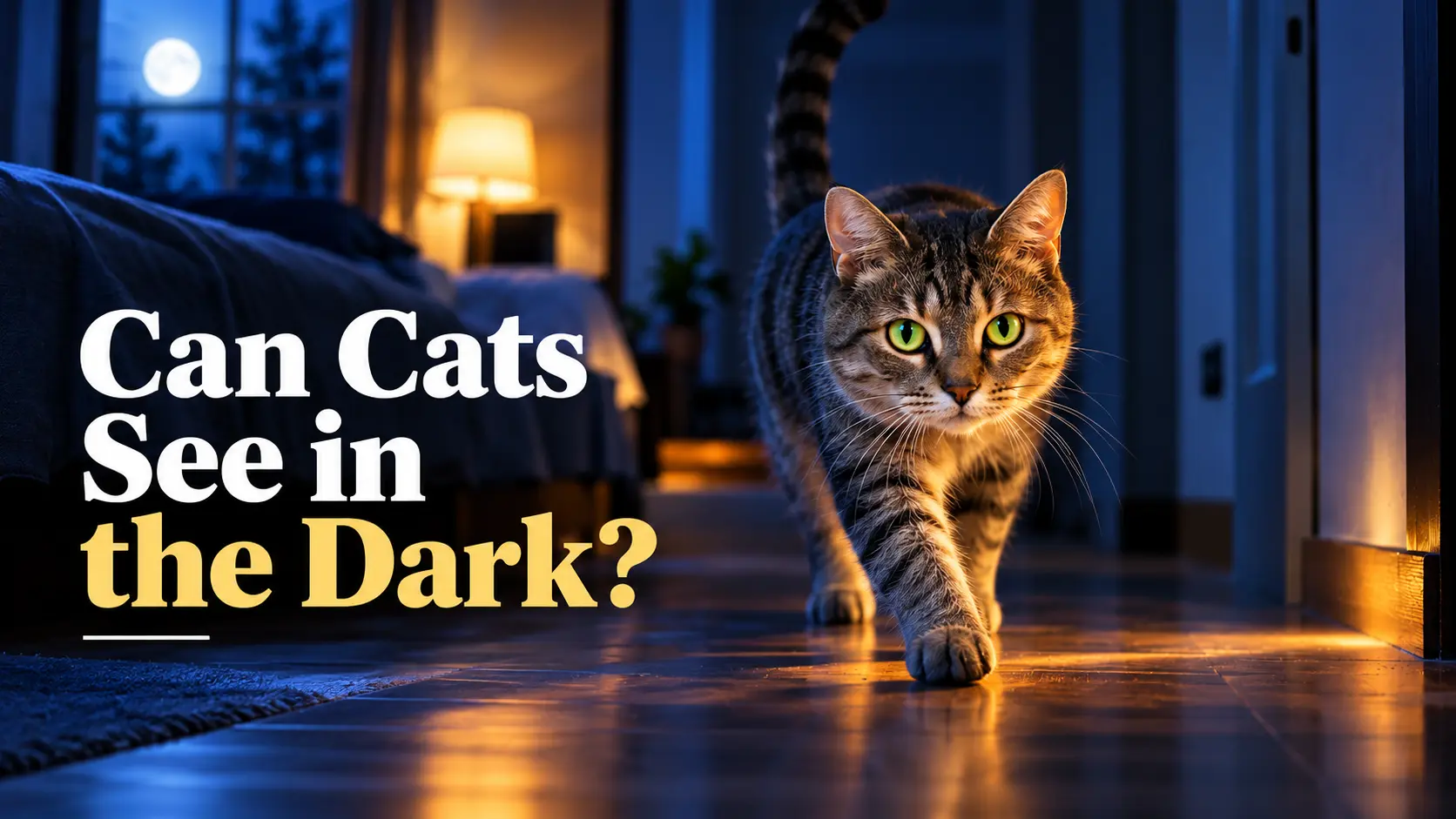
If you have ever watched your cat confidently walk through a dim hallway at night you may have wondered can cats see in the dark?
The short answer is cats can see extremely well in low light, but they cannot see in complete darkness. Their eyes are specially adapted to collect and reuse small amounts of available light, which gives them much better low-light vision than humans. So your cat does not have true night vision. Instead, their eyes make remarkably efficient use of moonlight, streetlight or even a faint glow coming from another room.
How Well Can Cats See In The Dark?
Cats can see much better than humans when lighting is poor. Sources from Purina and Cornell explain that feline eyes are substantially more sensitive to light than human eyes, largely because of their retinal structure and a reflective layer called the tapetum lucidum.
This is why your cat may move confidently around the house when you can barely make out the furniture. However, there is one important limitation:
A cat still needs some light to see. In a room with absolutely no light reaching the eyes, a cat cannot visually see objects any more than a human can. Cats Protection similarly notes that cats do not have true vision in total darkness; their advantage appears under low-light conditions.
Why Can Cats See So Well At Night?
A cat’s impressive low-light vision comes from several features working together.
1. Cats Have More Light-Sensitive Rod Cells
The retina contains photoreceptor cells known as rods and cones.
Rods are especially important for detecting:
- dim light
- movement
- shapes
- peripheral activity
Cats have a much stronger emphasis on rod-based vision than humans, making them especially capable of detecting movement under dim conditions. That is extremely useful for an animal whose ancestors hunted small, fast-moving prey around dawn and dusk.
2. Their Pupils Can Become Very Large
You have probably noticed that your cat’s pupils change dramatically. In bright daylight, they may narrow into thin vertical slits. In a dark room, they can expand until much of the visible eye looks black. Those enlarged pupils allow more available light to enter the eye, improving the cat’s ability to see when illumination is poor.
3. Cats Have a Tapetum Lucidum
One of the most important structures behind cat night vision is the tapetum lucidum. It is a reflective layer located behind the retina. Light that passes through the retina without being absorbed can be reflected back through it, giving the photoreceptors another opportunity to capture that light. This is also responsible for the familiar glowing-eye effect you may see when headlights or a camera flash hit a cat’s eyes.
Can Cats See In Complete Darkness?
No. This is probably the biggest misconception about feline eyesight.
A cat’s eyes are excellent at amplifying small amounts of existing light, but they cannot create visual information when there is no light at all. Purina specifically notes that cats require at least some illumination to see.
Think of it this way:
- Dim room: cat can probably navigate very well.
- Moonlit yard: excellent conditions for feline vision.
- Room with every source of light completely blocked: visual ability becomes extremely limited because there is no light for the retina to process.
Even then, a cat may still move surprisingly well because vision is only one of the senses it uses.
How Do Cats Move Around When It Is Almost Completely Dark?
Cats combine eyesight with other highly developed senses.
- Their whiskers help them detect nearby objects and subtle changes around their face. Their excellent hearing can also help them identify where movement is occurring.
- This means a cat navigating your bedroom at night may not be relying entirely on its eyes.
- Memory of the home’s layout also helps. A cat that has lived in the same house for months already knows where the bed, doorway, couch, litter box, and furniture are located.
That combination can make its nighttime movement look almost effortless.
Can Cats See Better In The Dark Than Humans?
Yes under low-light conditions. Humans generally have an advantage in sharp daytime detail and richer color perception, while cats are considerably better adapted for dim environments.
A simple comparison looks like this:
| Vision Feature | Cats | Humans |
| Low-light vision | Excellent | Limited |
| Complete darkness | Cannot see | Cannot see |
| Motion detection in dim light | Excellent | Weaker |
| Color range | More limited | Broader |
| Bright daylight detail | Lower | Better |
| Peripheral field | Wider | Narrower |
So Asking whether cats have better eyesight overall is not quite accurate. Their eyes are simply optimized for a different job.
Are Cats Nocturnal?
Not exactly. Cats are commonly described as crepuscular, meaning they tend to be naturally active around dawn and dusk rather than being strictly nocturnal animals.
- Those are also times when many prey animals are active.
- Their low-light eyesight therefore makes perfect evolutionary sense.
- Domestic cats may still race through your house at midnight, of course. Their routines can also adapt around feeding schedules, indoor life, and the habits of their owners.
What Do Cats See In The Dark?
Cats do not see a bright, perfectly detailed version of the room. Their visual system prioritizes movement and light sensitivity over sharpness and rich color.
In dim conditions, a cat is particularly good at noticing things such as:
- a small animal moving across the floor
- subtle shadows
- changes in brightness
- movement at the edge of its visual field
Fine details are not their strongest point. Cats are generally more nearsighted than humans, and their visual acuity is considerably lower than typical human vision.
What Colors Can Cats See In The Dark?
Cats can see color, but their color perception is much more limited than ours. Their visual world appears to emphasize shades in the blue and yellow-green range more than vivid reds or pinks. Colors also appear less saturated compared with how humans experience them. At night, color becomes even less important because low-light vision relies heavily on rod cells.
This means your cat is paying far more attention to brightness, shape, contrast and movement than to whether an object is red or green.
Can Cats See Red Light In The Dark?
Cats do not perceive red in the same rich way humans do. Their color vision is limited because they have fewer color-sensitive cone cells than humans. Reds and pinkish shades may therefore appear much duller or be confused with other tones.
However, whether a cat detects an object in low light depends on more than its color. Movement, contrast, brightness and distance can matter even more.
How Far Can Cats See In The Dark?
There is no single distance at which every cat suddenly stops seeing.
Visibility changes depending on:
- how much light is available
- the size of the object
- whether it is moving
- contrast with the background
- the cat’s individual eyesight
Cats are particularly good at detecting movement, but they do not see distant fine detail as sharply as humans. Notes that feline visual acuity is commonly estimated around 20/100 to 20/200, meaning an object a human sees clearly from much farther away would need to be considerably closer for a cat to see with similar sharpness.
Can House Cats See in the Dark?
Yes, domestic house cats have the same basic low-light adaptations. Whether your cat is a Persian, Siamese, Bengal, black cat, tabby, or mixed breed, its eyes are designed to function efficiently under dim conditions.
Individual vision can still vary because of:
- age
- genetics
- eye disease
- injury
- other health conditions
So breed or coat color does not suddenly give a cat supernatural night vision.
Can Black Cats See In The Dark?
Yes, But not because they are black.
- A cat’s coat color has no meaningful connection to whether its retina can process dim light.
- Black cats have the same core nighttime adaptations as other domestic cats: large pupils, rod-rich retinas, and a tapetum lucidum.
- Their dark fur may make them harder for you to see in a dark room, but it does not make their own eyesight stronger.
Can Kittens See In The Dark?
Young kittens are born with immature vision. Their eyes typically begin opening during the first couple of weeks of life, and their visual ability continues developing afterward. Purina notes that kittens initially have limited eyesight and gradually develop adult-level vision over the following months.Once their eyes mature, healthy kittens develop the same general low-light advantages seen in adult cats.
Can Cats See Better In The Dark Than Dogs?
Both cats and dogs are adapted for low-light vision, and both possess structures that improve their ability to see under dim conditions. However, the exact comparison depends on multiple factors, including retinal anatomy, breed, individual vision, and what kind of visual task is being measured.
Instead of thinking of it as a simple winner-versus-loser comparison, it is more accurate to say that both species see far better in dim environments than humans do, while cats are especially well adapted to hunting during low-light periods.
Do Cats See Better In The Dark Than In The Light?
Not exactly. Cats are exceptionally well adapted to dim light, but that does not mean darkness produces their best possible vision. Very bright daylight can reduce some of their advantages compared with humans, while complete darkness leaves them without enough light to form visual images.
Their visual system works especially well around the middle ground: low-light environments such as dawn, dusk or a dimly lit room.
Should I Leave a Light On For My Cat At Night?
A healthy adult cat usually does not need a bright room throughout the night. If there is some ambient light from windows, hallways, outdoor lighting, or another room, your cat can generally navigate the home easily.
A small night-light may still be useful for:
- senior cats
- cats with vision problems
- newly adopted cats learning a home
- homes with unfamiliar obstacles or stairs
Avoid suddenly rearranging furniture if your cat has poor eyesight because familiarity with the environment can help it move around safely.
Is It Cruel To Leave a Cat In The Dark?
Normal nighttime darkness is not inherently cruel for a healthy cat. Cats are naturally comfortable in low-light environments.
What matters more is that your cat has safe access to:
- water
- its litter box
- a comfortable sleeping area
- familiar pathways
- food when appropriate
A completely unfamiliar environment with hazards is different, particularly for elderly or visually impaired cats.
Why Do Cats’ Eyes Glow In The Dark?
Technically, a cat’s eyes do not generate their own light.
- The glowing appearance occurs when external light enters the eye and reflects from the tapetum lucidum behind the retina.
- That reflected light travels back toward the observer, making the eyes appear bright.
- It is the same structure that improves the cat’s ability to make use of limited illumination.
When Night Vision Changes Could Be a Problem
A healthy cat should usually move confidently through familiar low-light surroundings. A sudden change is worth paying attention to.
Signs that may indicate an eyesight problem include:
- bumping into objects
- difficulty judging jumps
- hesitation around stairs
- unusually enlarged or unequal pupils
- cloudy eyes
- eye redness
- excessive tearing
- suddenly becoming reluctant to move in dim rooms
Cats can develop several eye conditions that affect vision, so sudden or progressive changes deserve veterinary attention. Cornell notes that feline vision problems can arise from a variety of causes and may sometimes threaten eyesight.
Final Thoughts
So can cats see in the dark? Not in total darkness but their low-light eyesight is far more capable than ours. Large pupils collect available light, rod-rich retinas detect faint movement, and the tapetum lucidum reflects light through the retina again. Together, these features help cats navigate and hunt effectively around dawn, dusk and other dim environments.
It may look as though your cat has built-in night-vision goggles, but the reality is even more interesting: feline eyes are simply exceptionally well designed to make the most of whatever little light is available.