

Leaving your dog or cat with another person is a big decision. A pet sitter may be responsible for feeding, exercise, medications, bathroom breaks, companionship, emergency decisions and in many cases access to your home. That is why finding someone should involve more than typing a pet sitter near me and choosing the first available profile.
The right sitter should fit your pet’s routine, temperament, health needs, and your expectations about communication. This guide explains what pet sitters do, what pet sitting costs in 2026, where to find local care, what questions to ask, which warning signs to notice and how to prepare your home and pet before you leave.
What Is a Pet Sitter?
A pet sitter cares for an animal while its owner is away or unavailable. Professional pet sitting often takes place in the pet’s own home, although everyday use of the term can also include boarding, drop-in care, overnight stays, and dog walking. Typical in-home care can involve feeding, fresh water, bathroom breaks, litter box cleaning, exercise, playtime, companionship, medication when agreed upon and basic home-related tasks.
Rover, for example, describes drop-in care as visits for feeding, play, water, bathroom needs, and other agreed tasks, while house sitting involves someone staying overnight in the pet owner’s home.
Pro Tip: The exact responsibilities should always be agreed upon before the booking.
Why Do Pet Parents Use In-Home Pet Sitting?
One of the main advantages of in-home care is that your pet can stay in familiar surroundings. This can be especially useful for cats that dislike travel, senior animals, pets that follow strict schedules, multi-pet homes, nervous dogs and animals requiring medication. The American Kennel Club notes that many dogs may experience less disruption when they remain at home and continue their usual routines. It also points out that in-home care avoids unnecessary exposure to unfamiliar dogs.
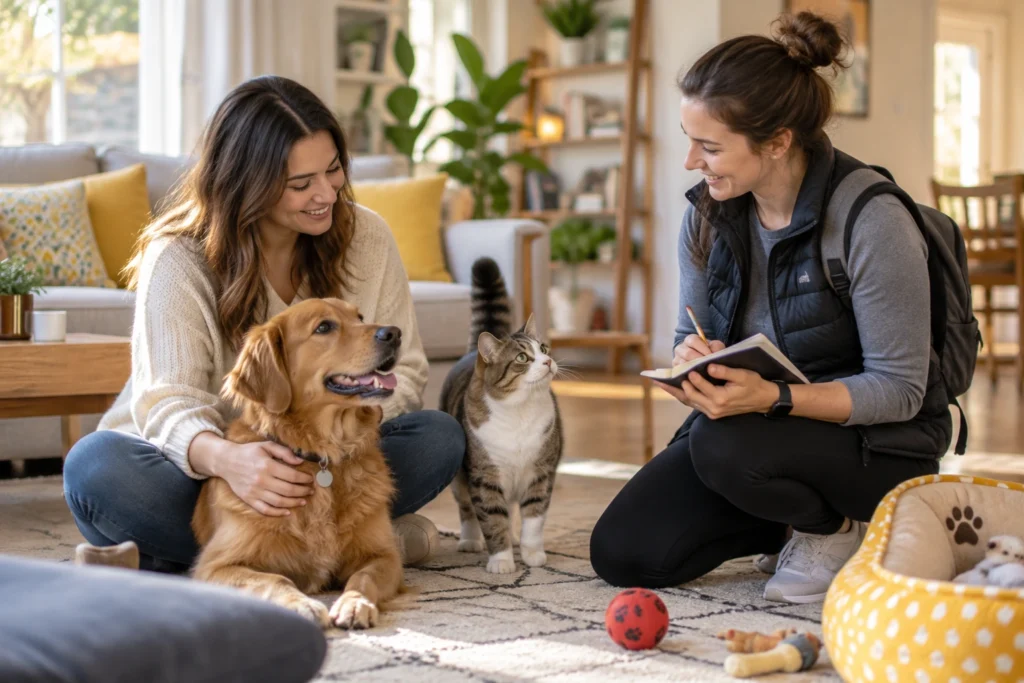
That does not make home pet sitting the right choice for every animal. Some dogs do well in reputable boarding environments. The decision should depend on the individual pet rather than a general rule.
What Does a Pet Sitter Actually Do?
A sitter’s job can look simple from the outside, but good care often involves dozens of small details. Suppose your dog normally eats at 7 a.m., takes medication with breakfast, walks twice a day, becomes reactive around bicycles and cannot comfortably remain alone longer than four hours.
Those details matter.
- For a cat, the important information might instead involve where the cat hides, how much food it normally eats, litter box habits, medication, and whether a normally social animal suddenly stops interacting.
- A sitter is not expected to diagnose an illness. They should, however, understand your pet’s normal routine well enough to notice meaningful changes and know whom to contact if something appears wrong.
Current discussions among pet sitters repeatedly emphasize routine, medications, the amount of time a pet can be left alone, behavior and clear expectations as important topics before accepting a booking.
Pet Sitter vs Dog Walker vs Boarding
These services overlap, but they solve different problems.
| Service | Where care happens | Typical purpose |
| Pet sitting | Usually your home | General care while you are away |
| Drop-in visit | Your home | Feeding, play, litter care and short check-ins |
| Dog walking | Home/neighborhood | Exercise and bathroom breaks |
| House sitting | Your home | Overnight or extended supervision |
| Boarding | Sitter’s home/facility | Overnight care away from your home |
| Dog daycare | Caregiver/facility | Daytime supervision and activity |
Rover currently offers boarding, house sitting, daycare, dog walking, and drop-in visits, which illustrates why the term pet sitting can refer to several different arrangements. Always confirm what your particular booking includes.
How Much Does a Pet Sitter Cost in 2026?
There is no single pet sitting rate for the entire United States. As of September 2026, Care.com reports a national average posted pet-sitter rate of about $16.63 per hour, but location makes a significant difference. Its current data shows examples such as approximately $14.55 per hour in Dallas, $18.35 in Chicago, $19.58 in San Diego, and $22.09 in Seattle.
Your actual cost can also change according to the number of animals, visit length, overnight care, holidays, medication, travel distance, puppy care, senior-pet needs or the amount of time a sitter must remain in your home.
- How much does a pet sitter cost?
- What does this rate include for my particular pet?
Is $30 a Day Good For Pet Sitting?
It depends on the service. Thirty dollars might be reasonable for a limited visit in some locations, while it could be too little for multiple visits, long walks, medication, or extended supervision. It is also important not to confuse an hourly price, a drop-in price, and a daily or overnight price.
For comparison, Rover’s August 2026 guide lists a typical drop-in visit range of roughly $16–$25 per visit, although individual prices and locations vary. So $30 by itself tells you very little until you know what care is included.
Is $100 a Day Good For Dog Sitting?
A $100 daily rate can also be reasonable depending on the arrangement. A sitter providing overnight care, several walks, medication, care for multiple animals, or substantial daytime supervision is performing a different job from someone making one short visit.
Care.com’s 2026 guidance similarly notes that pet-sitting prices depend on the type and extent of service rather than one universal rate. Compare responsibilities first and price second.
How To Find a Trusted Pet Sitter Near You
Online marketplaces are one option, but they are not the only one. Pet Sitters International recommends taking time to interview potential sitters, arranging an in-home meeting, and checking references. The National Association of Professional Pet Sitters similarly recommends reviewing services, conducting an interview, checking references, verifying insurance where appropriate and letting the sitter meet your animal in your home. Personal referrals can also be valuable. You can ask friends, neighbors, your veterinarian, groomer, trainer or local humane organization.
Humane World for Animals specifically suggests firsthand recommendations as well as professional pet-sitting organizations and online/community resources when searching for a sitter.
What Pet Owners Are Saying In Online Communities
Current pet-sitting discussions add an important practical layer to the professional advice. In a May 2026 Reddit discussion, an owner of a senior dog and cat with medical needs asked how to find a reliable overnight sitter. Responses emphasized checking insurance, speaking with references, arranging a meet-and-greet, and asking how the sitter handles emergencies such as sick or missing animals. Local Facebook community pages were also suggested as a source for referrals.
Popular Websites For Finding Pet Sitters
Several established websites and apps can help owners find care. They operate differently, so the company itself should be viewed as the place where your search begins not as a substitute for evaluating the individual sitter.
Rover
Rover offers house sitting, boarding, drop-in visits, dog walking, daycare, and related services. Owners can compare sitter profiles and reviews, contact candidates, and arrange a meet-and-greet before booking. It can be particularly useful when you want to compare several local caregivers in one place.
Wag!
Wag! connects pet owners with caregivers for dog walking, drop-in visits, overnight sitting, boarding, daycare, and other services. The company says caregivers on its platform undergo background checks, and the app supports messaging, GPS tracking for relevant services, and photo/video updates.
Care.com
Care.com is a broader caregiving marketplace that also includes pet sitters. Because it covers more than pet care, look closely at each person’s animal-related experience, services, rates, and references rather than assuming all listed caregivers offer the same expertise. Its September 2026 directory contains tens of thousands of pet-sitter listings.
Fetch! Pet Care
Fetch! Pet Care focuses specifically on professional pet care. Its services include in-home sitting, dog walking and, depending on the location and provider, medication-related assistance and extended care. Fetch says pet-sitting visits can include written updates, arrival and departure information, photos, videos, and reports about food, water, bathroom activity, and temperament.
TrustedHousesitters
TrustedHousesitters works differently from a traditional paid pet-sitting marketplace.
- Pet owners and sitters pay for memberships, and the sitter provides home and pet care in exchange for accommodation rather than receiving a normal pet-sitting payment from the homeowner.
- That structure may appeal to owners looking for live-in care, particularly for longer trips, but you should still review the sitter, communicate expectations, and confirm that the arrangement suits your pets.
App, Independent Sitter, or Local Recommendation?
There is no single sourcing method that works best for every household. Apps can simplify reviews, booking, communication, and payment. An established independent professional may offer more continuity and a long-term relationship. A neighbor or referral may already be familiar with your area. Local Facebook and neighborhood groups can also uncover experienced independent sitters who do not rely heavily on large marketplaces.
What matters is what happens after you find the name.
- Check experience. Talk to the person. Ask questions. Verify information where appropriate. Let them meet your animal.
- The platform should help you discover candidates; it should not make the final decision for you.
Arrange a Meet-And-Greet
A meet-and-greet is one of the most useful parts of the selection process. PSI recommends meeting potential sitters in person so you can observe their interaction with your pet and review credentials, policies, and services. AKC similarly recommends an in-home consultation before hiring. It can also reveal details that profiles cannot.
A sitter may look excellent online but appear uncomfortable handling your large dog. Another sitter may immediately understand that your shy cat needs space rather than forced interaction. For a long trip or a pet with complicated needs, consider scheduling a short trial visit before the full booking.
Questions To Ask Before Hiring a Pet Sitter
You do not need to conduct an intimidating interview, but you should leave the conversation knowing what will happen while you are away.
Ask:
- What experience do you have with pets like mine?
- How long is each visit, and how many visits will there be?
- How long might my pet be left alone?
- Will you personally provide the care?
- What happens if you become sick or unavailable?
- How do you handle a pet emergency?
- Are you comfortable with my pet’s medication?
- Do you have pet first-aid or CPR training?
- Do you carry appropriate insurance if you operate professionally?
- Can you provide references?
- How often will you send updates?
- Will those updates include photos?
- What is included in the quoted rate?
- What is the cancellation policy?
- Is there a backup sitter if something goes wrong?
These questions cover the issues that professional organizations and current pet-care communities repeatedly identify as important without asking the same thing several different ways.
Communication Matters More Than Many Owners Expect
One of the clearest themes in recent community conversations is communication. In a June 2026 discussion, one cat owner described being unhappy because updates were generally provided only after the owner asked. Other pet-sitting discussions show that owners and sitters have very different preferences: some expect an update after every visit, while others prefer a daily message. Neither frequency is automatically correct.
The problem usually begins when nobody agrees on expectations. Before leaving, decide whether you want a message after every drop-in, once per day, or only when something unusual happens. Also agree on whether you expect photographs, feeding confirmation, medication confirmation, bathroom information or arrival/departure updates.
Platforms and professional services increasingly build these updates into the care experience. Fetch, for example, describes visit journals containing timing, food, water, bathroom, temperament, photo, video and written updates. Clear expectations reduce unnecessary worry for both sides.
What Are Red Flags In a Pet Sitter?
A warning sign does not automatically prove someone is irresponsible. Look at the overall pattern. A sitter deserves additional scrutiny if they refuse a reasonable meet-and-greet, cannot explain what happens during an emergency, are vague about how long your animal will be alone, repeatedly contradict agreed care instructions, cannot provide references when presenting themselves as an established professional, or will not clarify who actually has access to your home. AKC specifically identifies unwillingness to meet the owner and dog beforehand as a reason to look elsewhere. It also recommends discussing emergency backup arrangements.
Should a Professional Pet Sitter Have Insurance?
If someone operates a professional pet-sitting business, asking about insurance is reasonable.
- PSI includes insurance and bonding among the issues owners should discuss during screening, while NAPPS recommends confirming appropriate liability insurance and bonding.
- Insurance does not tell you whether a person will bond well with your cat or patiently walk your nervous dog. It simply addresses a different type of risk.
- Community discussions in 2026 also frequently raise insurance when owners are comparing professional independent sitters.
If you use an app, read that company’s current protection terms separately rather than assuming platform protection and a sitter’s own insurance are the same thing.
Choosing a Sitter For a Dog
Dogs often require more detailed scheduling. Explain how much exercise your dog normally receives, the maximum amount of time they can comfortably be left alone, feeding times, leash or harness rules, bathroom routines, interactions with other animals, escape risks and any known triggers.
Behavior information is particularly important. If your dog is reactive around bicycles, strangers, children, or other dogs, say so before the booking. A sitter cannot safely follow a plan they were never told about.
Choosing a Sitter For a Cat
Cats do not necessarily require less care they often require a different style of care. Explain feeding and water routines, litter habits, hiding places, medication, favorite toys, normal social behavior and any areas of the home the cat should not access.
Tell the sitter what normal looks like. A cat that always hides from strangers may be behaving normally when it disappears under a bed. If a normally social cat suddenly refuses to appear or eat, that could be much more significant.
Extra Care For Senior Pets And Pets With Medical Needs
Experience becomes more important when a pet has complicated medical needs.
- A senior animal may need medication at specific times, extra bathroom breaks, mobility assistance or closer observation.
- This concern appears frequently in pet-owner discussions. The May 2026 thread about finding an insured overnight sitter, for example, came from an owner specifically caring for a senior dog and cat with medical needs.
- Ask the sitter what they have actually done before rather than accepting a vague statement that they are good with pets.
- Some professional services also offer specialized medication support. Fetch! Pet Care, for example, describes medication-administration services for prescribed pills, injections, fluids and other scheduled treatment where available.
- For complicated medical care, confirm the plan with your veterinarian.
Prepare Written Care Instructions
Even an excellent sitter cannot remember every detail from a conversation. Leave one clear care document containing feeding amounts and times, medication instructions, walking or litter routines, behavioral information, veterinarian details, emergency contacts, your travel contact information and any important home-access instructions.

Show the sitter where the food, medication, leash, carrier, litter supplies, cleaning products, towels, waste bags and emergency items are stored.
A written plan also prevents repeated messages while you are traveling.
Create an Emergency Plan Before You Leave
Do not wait for an emergency to decide what an emergency plan should be. Your sitter should know which veterinarian your pet normally visits, where the nearest emergency clinic is, how to transport your pet, who should be contacted if you cannot be reached, what medical conditions already exist, which medications your pet takes, and where the carrier is located.
You should also discuss your preferences for authorizing urgent veterinary care. A good emergency plan is not a prediction that something will go wrong. It simply prevents valuable time from being lost if something does.
Is a Pet Sitter Better Than Boarding?
Neither option is universally better.
- In-home pet sitting may suit animals that depend heavily on familiar routines or become stressed by unfamiliar environments.
- Boarding may suit other dogs, particularly when the facility and level of supervision match their temperament and needs.
- Think about your pet’s age, health, personality, social behavior, medication requirements and tolerance for change.
The best arrangement is the one that fits the individual animal.
Final Takeaway
Finding a good pet sitter is not about discovering the cheapest person or the biggest pet-care app. It is about matching your pet with the right level of care.
Platforms such as Rover, Wag!, Care.com, Fetch! Pet Care and TrustedHousesitters can help you discover potential caregivers. Friends, veterinarians, professional sitter directories, and local Facebook or neighborhood groups can also provide useful leads. But whichever route you use, do the same basic work afterward: review experience, arrange a meet-and-greet, clarify the schedule, discuss emergencies, agree on communication and leave detailed written instructions.
Those steps matter even more for senior pets, animals taking medication, anxious pets, and households that need overnight care. A sitter does not need to be the most expensive or have the flashiest profile. They need to understand your pet, your expectations, and the responsibility they are accepting.