
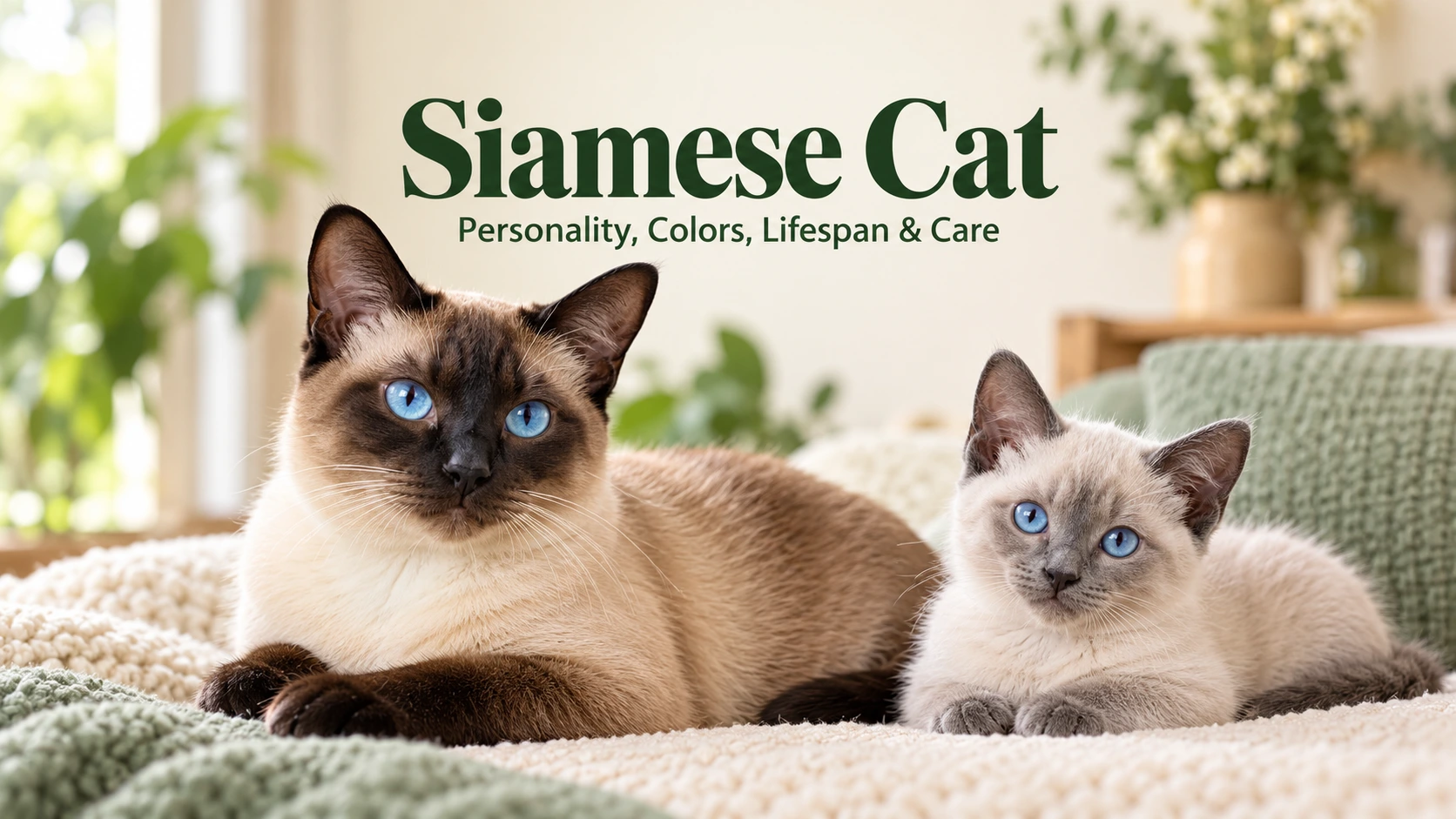
A Siamese cat rarely lets you forget they’re in the room. They might follow you into the kitchen, claim the warm spot beside your laptop or answer back when you speak. Their blue eyes catch your attention first but their outgoing personality often leaves the biggest impression. Living with one means making room for a cat that enjoys being involved. Before bringing a Siamese kitten home, it helps to understand their need for company, their coat variations and the care they require.
What Is a Siamese Cat?
The Siamese is a shorthaired cat breed originating in Thailand, formerly known as Siam. Its signature appearance combines blue eyes, a pale body and darker markings called points on the face, ears, legs and tail. Modern Siamese cats have slender, muscular bodies, large ears and wedge-shaped heads. The Cat Fanciers’ Association describes the breed as affectionate, active and vocal, which explains why these cats appeal to people looking for an interactive companion.
Siamese Cat Breed At a Glance
| Feature | What To Expect |
| Origin | Thailand |
| Size | Small to medium |
| Adult weight | Approximately 5–8 pounds for females and 8–12 pounds for males |
| Coat | Short and close-lying |
| Eye color | Blue |
| Personality | Social, playful, affectionate, and talkative |
| Companionship needs | Frequent interaction |
| Grooming | Generally straightforward |
Weight ranges are a guide rather than a target for every cat. TICA lists these approximate adult weights, but your veterinarian should assess your cat’s individual body condition.
Siamese Cat Personality What Are They Like?
- Siamese cats tend to take an active interest in household life. Opening a cupboard, folding laundry or settling onto the couch may quickly attract a curious companion.
- They are often affectionate and expressive. Some enjoy sitting on laps, while others prefer staying close enough to supervise whatever you’re doing.
- Their voice is another defining trait. A Siamese may meow to greet you request attention or make an opinion about dinner perfectly clear. TICA describes them as highly social cats that thrive on interaction and dislike being alone for extended periods.
- That reputation still leaves plenty of room for individuality. Meeting the actual cat tells you more about compatibility than a breed description alone.
Siamese Cat Colors And Point Patterns
The four traditional Siamese colors recognized by the Cat Fanciers’ Association are seal point, chocolate point, blue point and lilac point.
| Color | Typical Appearance |
| Seal point Siamese | Cream to pale fawn body with very dark brown points |
| Chocolate point Siamese | Ivory body with warmer, milk-chocolate points |
| Blue point Siamese | Cool, pale body with slate-gray points |
| Lilac point Siamese | Pale body with light, pinkish-gray points |
Blue describes the gray tone of the markings, rather than a bright blue coat.
What About Lynx Point And Flame Point Siamese Cats?
A lynx point has tabby-style stripes within the darker markings. A flame point, often called a red point, has orange or reddish points. Registration rules differ. TICA accepts a wider range of pointed colors and patterns, while CFA limits its Siamese breed classification to the four traditional colors. This explains why similar-looking cats can appear under different breed labels.
Siamese Cat Types Modern And Traditional
People often use Siamese cat types to describe differences in body shape. The modern Siamese has the long, fine-lined appearance commonly associated with cat shows. Cats described as traditional, old-style or applehead Siamese generally have rounder heads and a less extreme build. These everyday labels do not always match registration categories. TICA recognizes the Thai as a separate breed associated with the old-style Siamese appearance. If pedigree status matters to you ask which registry and breed standard the breeder follows.
Are Fluffy or Long-Haired Siamese Cats a Separate Breed?
A recognized Siamese has a short coat. The closely related Balinese is the longhaired member of the Siamese breed group. A cat advertised as a fluffy Siamese might therefore be a Balinese, a mixed-breed cat, or another pointed breed. Blue eyes and darker markings alone cannot establish ancestry.
How Long Do Siamese Cats Live?
A practical general estimate for the Siamese cat lifespan is around 12–15 years, although individual cats may live considerably longer. VCA lists 12–15 years, while TICA notes that some Siamese reach more than 20 years. These figures describe possibilities across a population. They cannot predict how long an individual kitten will live.
How Much Does a Siamese Cat Cost?
Siamese cat prices vary with location, age, pedigree, breeder practices and what is included in the purchase. For a broad U.S. reference, WebMD reports a purchase range of approximately 600–2,500. Treat this as an indicative range, rather than a current quote from a particular breeder. Adoption fees also vary by organization.
Before paying a deposit request:
- Veterinary and vaccination records.
- Details of relevant parental health screening.
- Registration information if the kitten is advertised as pedigreed.
- A written agreement explaining the terms of purchase.
- Information about the kitten’s upbringing and socialization.
The initial price is only part of the commitment. Include food, litter, routine veterinary care, supplies and unexpected treatment in your budget.
How To Care For a Siamese Cat
Feeding And Healthy Weight
Choose a complete and balanced cat food appropriate for your cat’s life stage. Look for a nutritional adequacy statement on the packaging rather than relying on marketing claims. Portions should reflect age, activity, and body condition. Your veterinarian can help you decide how much to feed, particularly if your cat is gaining weight. Food puzzles can also make mealtimes more engaging.
Grooming And Shedding
The Siamese coat is relatively easy to maintain. A gentle weekly combing usually helps remove loose hair, and routine bathing is rarely necessary. They do shed, even though their short coat may leave less noticeable hair around the house than a long coat. VCA describes their grooming requirements as minimal.
Play And Climbing Space
Provide sturdy climbing furniture and places to explore. Siamese cats often enjoy heights, so an appropriate cat tree gives them a suitable outlet for climbing. VCA also highlights their active nature and tendency to become strongly attached to people and household companions. Daily interaction deserves as much consideration as grooming when planning their care.
Siamese Cat Health Issues To Know About
Being aware of breed-associated conditions helps you ask better questions. It does not mean every Siamese will develop them. Conditions discussed in veterinary breed guidance include:
- Amyloidosis: Abnormal protein deposits that can damage organs.
- Asthma: Airway disease that may cause coughing, wheezing or breathing difficulty.
- Hereditary Retinal Degeneration: An inherited condition that can affect vision.
- Pica: Eating nonfood objects, which can cause dangerous blockages.
- Dental Disease: A concern for Siamese and other cats.
Ask your veterinarian about preventive care and any screening relevant to your cat’s history.
Are Siamese Cats Hypoallergenic?
- No cat breed is truly hypoallergenic, including the Siamese. A short coat does not guarantee fewer allergy symptoms.
- Cat allergens come from proteins associated with saliva, skin and other secretions. The American Academy of Allergy, Asthma & Immunology advises that supposedly hypoallergenic breeds can still trigger reactions.
- If someone in your household has cat allergies, discuss the decision with an allergist before bringing a cat home.
Is a Siamese Cat Right For Your Home?
- A Siamese deserves consideration if you enjoy an affectionate, expressive companion and have time for regular interaction.
- Think carefully about your usual schedule. PDSA notes that Siamese can become lonely and emphasizes that introductions to existing pets should happen slowly. Another animal’s presence does not automatically guarantee companionship; compatibility matters.
- When visiting a rescue or breeder, describe your household honestly. Ask how the individual cat responds to handling, noise, other animals and time alone.
Conclusion
The appeal of a Siamese cat goes well beyond blue eyes and beautiful markings. Their curiosity, affection and willingness to join everyday life can make them memorable companions. Choose with your routine in mind. Meet the cat ask about health and temperament and budget for ongoing care. The right match is a cat whose needs you can comfortably meet for years to come.